Why does customer advocacy not have the attention of CMOs?
Why is it perceived as a vitamin and not a painkiller? Most CMOs file advocacy under case studies. The ones pulling ahead run it as a live trust signal across the whole revenue funnel.
Every CMO says customer advocacy matters. When asked you will hear "yes, references are important," or "yes we need to do more with our happy customers," or "yes we've got a case study programme." And yet, walk into almost any marketing organisation and look at where the budget is distributed, the headcount, or the strategic focus and advocacy sits somewhere near the bottom of the pile. Even when the CEO declares customers are our number one priority that doesn't translate to capturing and leveraging the "voice of the customer" at scale. It doesn't translate to a fully resourced and funded customer marketing department. It still in the main is owned by one person, or a small team at best and often gets deprioritised when budgets need to be cut. Yet this team unlike most marketing teams are closest to the customer and actually engage directly with customers. Ask the rest of the marketing team when did you last speak to a customer and you will no doubt be disappointed with the answer. The customer advocacy team are building relationships that go beyond the account manager, giving advocates more connections with your organisation. The more connections, the closer they feel and therefore the more loyalty you receive.
So why is there still a gap between what CMOs say about advocacy and the attention it receives? Is it purely an attention gap, a resource gap, an understanding gap or is the gap a categorisation failure? Is it because the overriding priority for most is customer acquisition and therefore customer advocacy is not perceived as helpful? Add the fact that historically customer advocacy has never been able to quantify its impact or ROI then maybe this has been the problem all along?
Customer advocacy positioning: post-sale, case study team
Generally, most CMOs would say customer advocacy is about capturing post sale sentiment. A happy customer gets referred to customer marketing, customer marketing books a call, writes it up, and the artifact goes into a library for sales to pull from on future deals. Useful, but structurally an afterthought. That placement is the misunderstanding in one sentence: advocacy is treated as something you produce after acquisition, when its highest-leverage use is acquisition itself.
A prospect evaluating you right now ultimately has one question in mind, what are you really like to work with? They want the unfiltered truth from someone who has nothing to gain by telling them, from someone who will explain the good and the bad and that someone will be more credible and convincing than a salesperson. Not rocket science, it's human behaviour to trust someone with first-hand experience. And when leveraged in a live reference call mid-deal the results speak for themselves.
The problem with the post-sale/case-study framing is that everything in it is optional and backward-looking. If the case study library is thin this quarter, nothing breaks because nothing in the current pipeline was actually depending on it. That's the problem: advocacy has been positioned as documentation of past wins, not as live infrastructure for winning the next one. If nothing depends on it, then why does it need any budget? Despite the understanding that the voice of the customer is truly powerful there is a reluctance across the organisation. A reluctance for marketing to invest, a reluctance from customer success to nominate and ask and a reluctance from sales to use references other than their "friends". The result ..never enough. Never enough relevant customer evidence, never enough proof points, never enough referenceable customers ....why are we surprised when the love and attention is elsewhere and the disconnect continues across the organisation.
Where it should actually sit: as a trust system across the revenue funnel
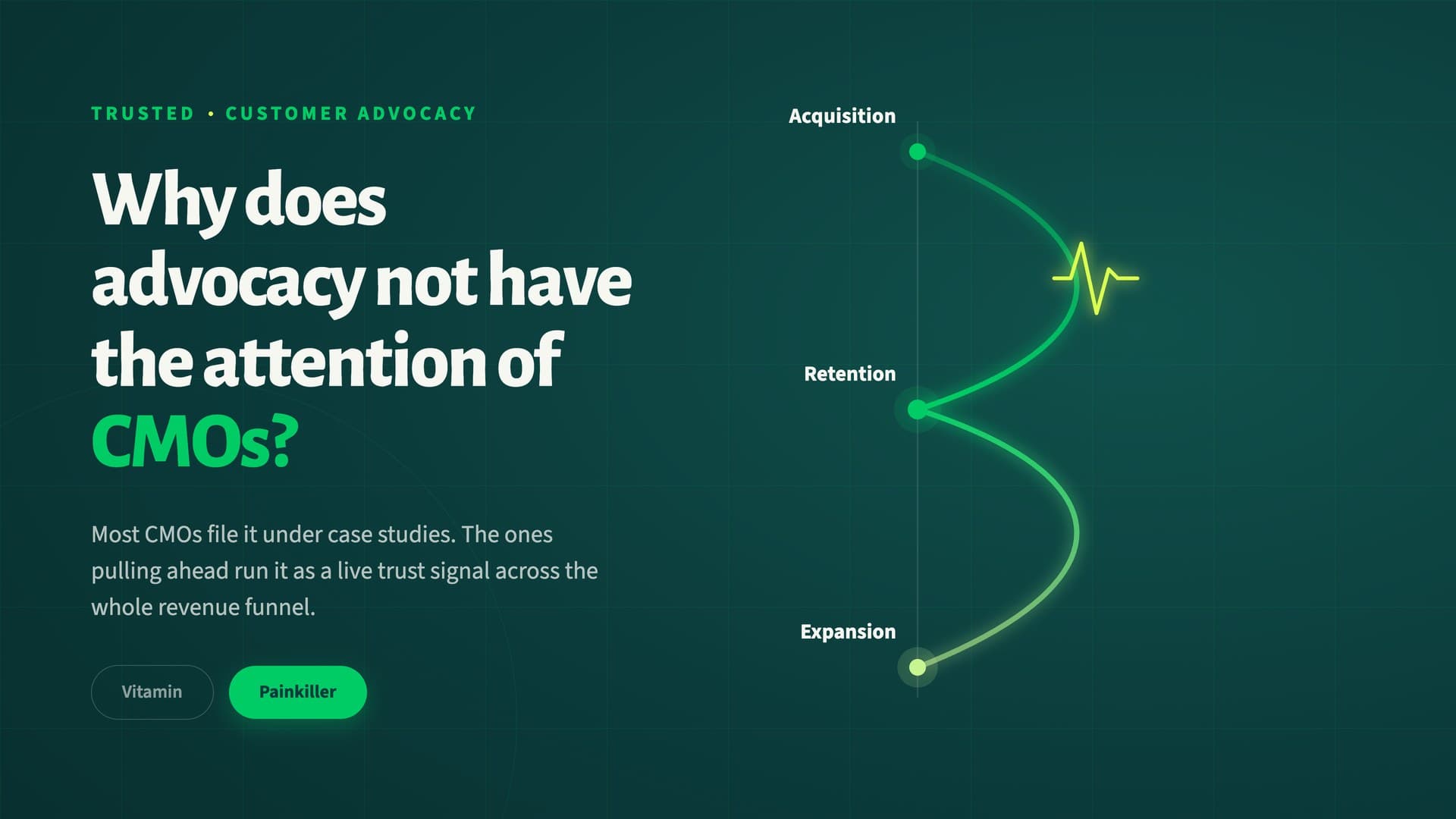
The reframe that changes everything is simple to state and hard to operationalise: advocacy is a trust-transfer mechanism that touches every stage of the customer lifecycle - acquisition, retention, and development.
What does this mean in practice?
Acquisition - a prospect trusts a peer's account of "what it's really like" more than anything a marketing team produces. Not only that, it is often the deciding input. And it works best live with a current customer speaking mid-deal and not as a case study written up months after the fact and filed away for the next prospect to stumble across.
Retention - the moment a customer would still vouch for you unprompted is also, almost exactly, the moment they're least likely to churn. Advocacy willingness is a leading indicator of account health that most companies aren't tracking at all, despite already sitting on the data that would reveal it.
Expansion - the accounts most willing to advocate are disproportionately the ones open to expanding, because advocacy and expansion both flow from the same underlying thing: a customer who feels the relationship is working in their favour, not just yours.
Once you see advocacy as a signal running continuously through all three of those motions, rather than a folder of quotes maintained for the sales team, the "afterthought" problem becomes obvious: A system predicting your renewals and flagging your expansion accounts, or helping with customer acquisition isn't something you bolt on later, unlike a passive content library. Customer advocacy is a game changer!
Three structural reasons why customer advocacy is the poor relation, and none of them are about CMOs not caring
It's been unmeasured, so it's been unmanaged. You can't build a strategic function around something you can't report on. Most advocacy activity such as a reference call here, a quote there, a customer mentioning you unprompted on LinkedIn happens in ad hoc siloed untracked moments. If it's not in a "trust" system or a system of record, it never reaches the board deck, and if it's not in a board deck, it doesn't get budget.
It's been treated as a favour economy, not a company wide asset. Customer marketers often talk about advocacy in terms of asking customers for things - a reference call, a quote, a case study - which frames the whole function as extraction. Reframed as capturing a trust signal that already exists in the market, it stops being an ask and starts being intelligence.
It's been owned by the function with the least leverage to make the case. Case study and customer marketing teams are usually small, sit downstream of the deal rather than inside it, and are structurally positioned to produce assets rather than argue for infrastructure. Their mandate is "write up what already happened," not "influence what happens next" - so even when they see the acquisition potential clearly, they have neither the seat nor the remit to act on it.
What changes when a CMO treats it as infrastructure instead
The CMOs who get real leverage from advocacy aren't the ones with the biggest case study libraries. They're the ones who've made advocacy visible and attributable, they make it tied to specific pipeline influenced, specific renewals saved and specific expansion conversations shortened, in other words it is tied to metrics everyone cares about.
That then completely changes the budget conversation and the airtime advocacy receives. No longer does the conversation revolve around how many customer stories are we going to produce this quarter/year - a deferrable ask but "here is the pipeline this function touched last quarter, and here's what it's predicting about renewal risk right now." This is very hard to cut, because by then it's not a marketing nice-to-have it's quantifiable customer acquisition, retention and development. It's a pain killer and not a vitamin.
The organisations that will pull ahead over the next few years are the ones who stopped treating advocacy as something you collect after the sale, and started treating it as a trust system you run - deliberately, continuously, and with the same rigour as any other function that touches revenue.